Growth Engines
We design and operate growth engines for ambitious B2B companies at critical growth stages—generating revenue, investors, and strategic opportunities through structured strategy and execution, not just advice.
A growth engine is not a campaign.
It is not a report.
It is not software you’re left to figure out.
A growth engine is a managed system—designed, built, and operated until it reliably produces outcomes.
Why Most Growth Efforts Fail
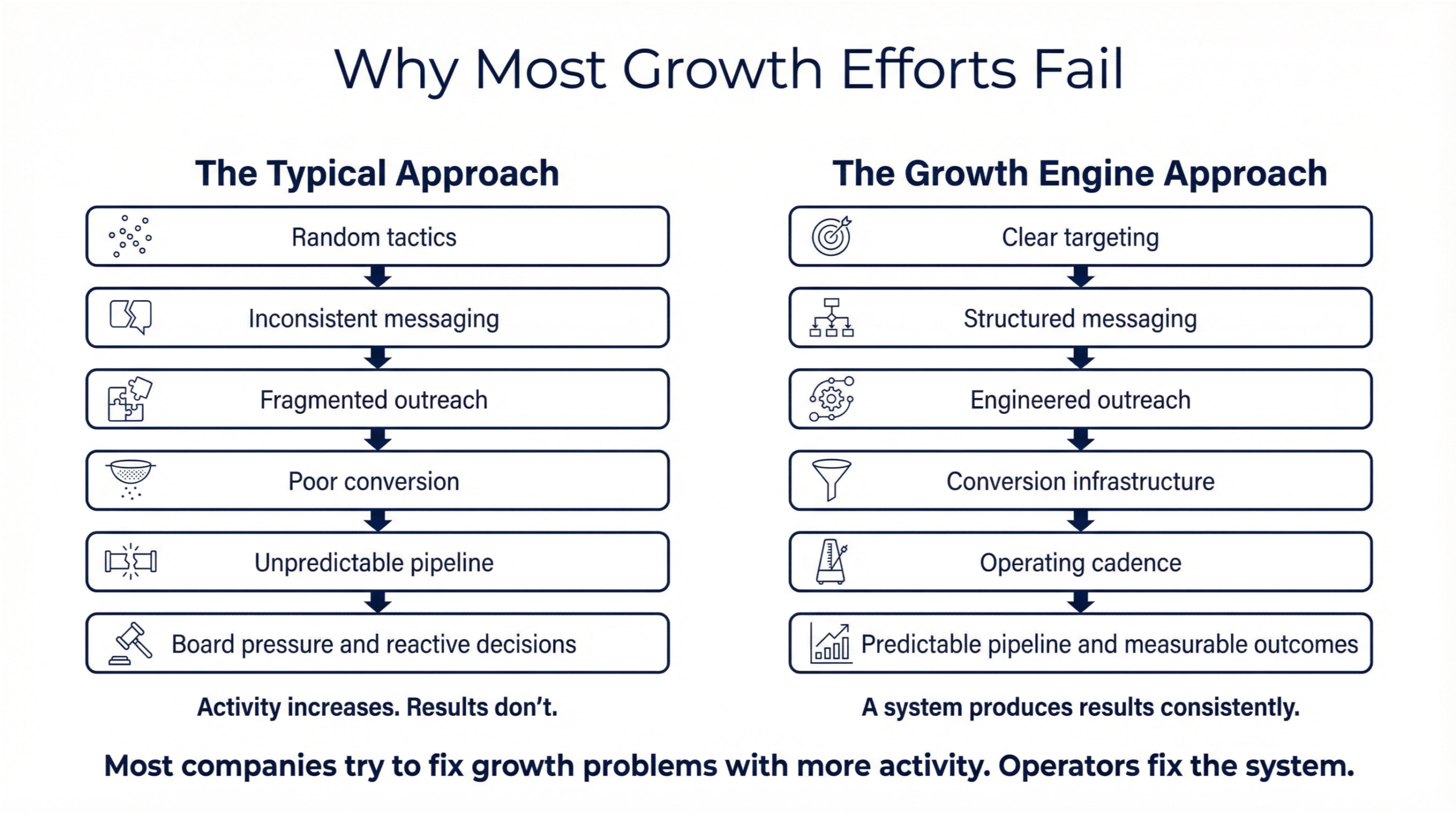
Most companies try to fix growth problems with more activity. Operators fix the system.
The SGS Growth Engine™
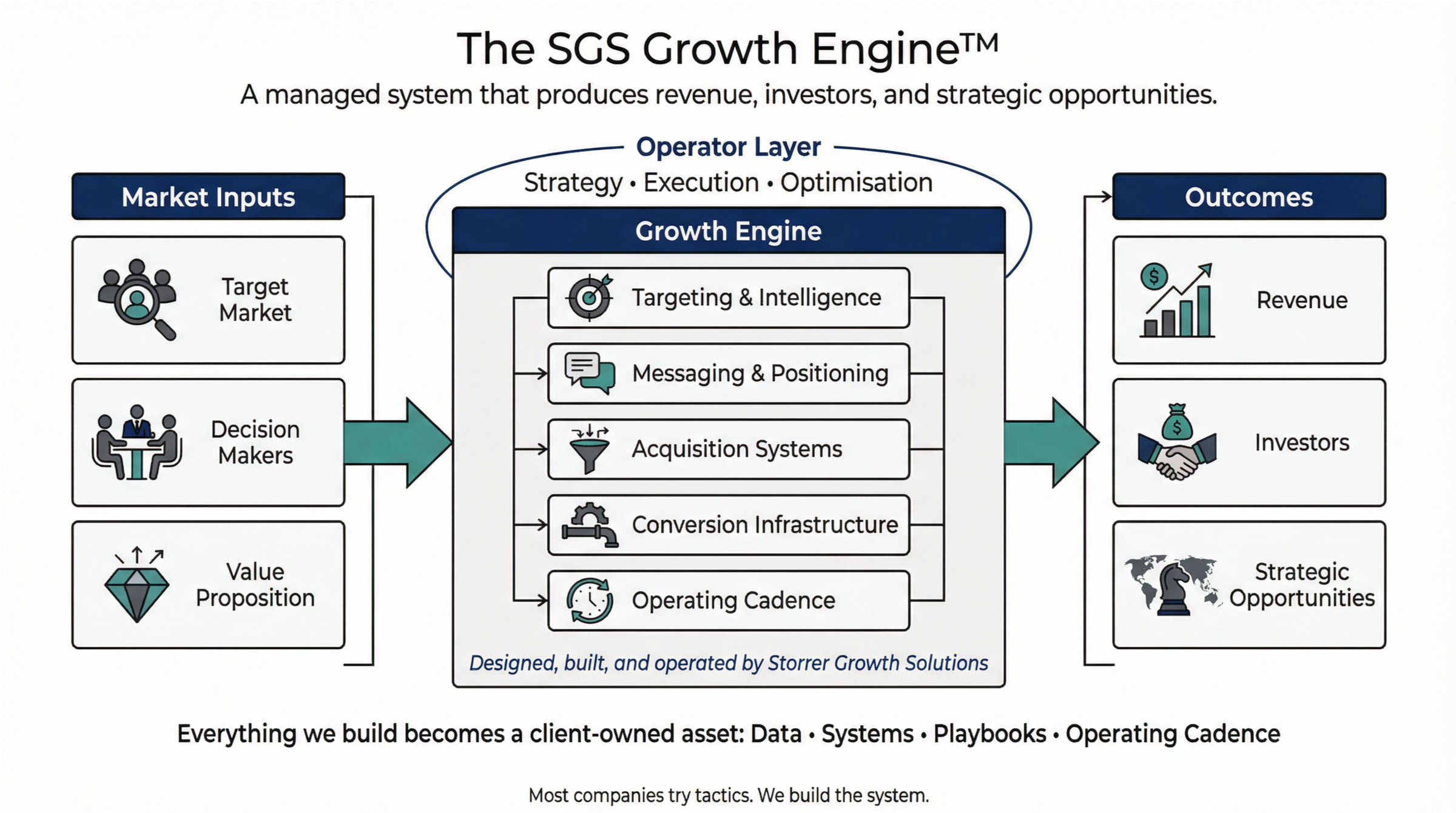
A managed system that produces revenue, investors, and strategic opportunities.
What a Growth Engine Produces
Most businesses don’t have a “lead problem”. They have an engine problem.
A functioning growth engine produces one or more of the following:
- Revenue: predictable qualified pipeline and sales outcomes
- Investors: a repeatable investor outreach and meeting-generation system
- Strategic opportunities: partnerships, buyers, acquisition targets, and market entry routes
When Companies Need a Growth Engine
SGS is typically engaged at moments where outcome pressure is high and time is limited:
- You need revenue growth in the next 90 days, not next year
- The board wants predictable pipeline, not sporadic wins
- You’re raising capital and need investor meetings quickly
- You’re pursuing acquisitions and need structured deal flow
- You’re entering a new market or launching a product and need execution, not theory
What a Growth Engine Includes
Every growth engine is built from a small number of repeatable components:
1) Targeting and Market Intelligence
We define who matters, why they would buy, and what triggers action.
- ICP and segmentation
- Target account lists
- Ownership intelligence and decision mapping (where relevant)
- Market/category positioning inputs
2) Messaging and Offer Clarity
We translate what you do into decision-grade language that compels action.
- Positioning narrative
- Use-case messaging
- Proof structure (measurable outcomes, credibility)
- Offer design (diagnostic, workshop, proposal)
3) Acquisition System
We implement structured outbound and/or partner channels that produce opportunities.
- Multi-step sequences (email, LinkedIn, partner routes)
- Reply handling logic
- Calendar conversion paths
- Compliance and deliverability foundations
4) Conversion Infrastructure
We ensure interest becomes meetings and meetings become pipeline.
- Landing pages and booking funnels
- Qualification workflows
- Follow-up and nurture automation
- Sales enablement assets (where needed)
5) Operating Cadence and Optimisation
We run the engine with disciplined governance until it performs.
- Weekly reporting and optimisation cadence
- Pipeline metrics and leakage analysis
- Continuous targeting and messaging iteration
How SGS Works
Most firms either advise or execute.
SGS does both, in the right order.
Step 1 — Diagnose and Design
We identify the constraint and design the engine to remove it.
Step 2 — Build
We build the infrastructure, assets, and workflows required to run.
Step 3 — Operate
We run the system and optimise until it produces reliable outcomes.
Step 4 — Transfer Ownership
Everything becomes a client-owned asset: data, systems, playbooks, and operating cadence.
No vendor lock-in.
No dependency.
Permanent capability.
What Makes SGS Different
Traditional agencies run campaigns.
Traditional consultancies write plans.
SGS is operator-led and system-led. We build and run the engine.
Led by Stuart Storrer (Royal Navy Lieutenant, Falklands veteran; Fortune 500 commercial leader; founder; turnaround operator), SGS brings operator judgement and disciplined execution—so growth becomes predictable, not hopeful.
Next Step: Growth Engine Diagnostic
An initial 15-minute working session to identify the constraint, map pipeline physics, and outline a 30/60/90 plan.